





The Future of XLR Audio Interfaces: Wireless Integration and Smart Controls

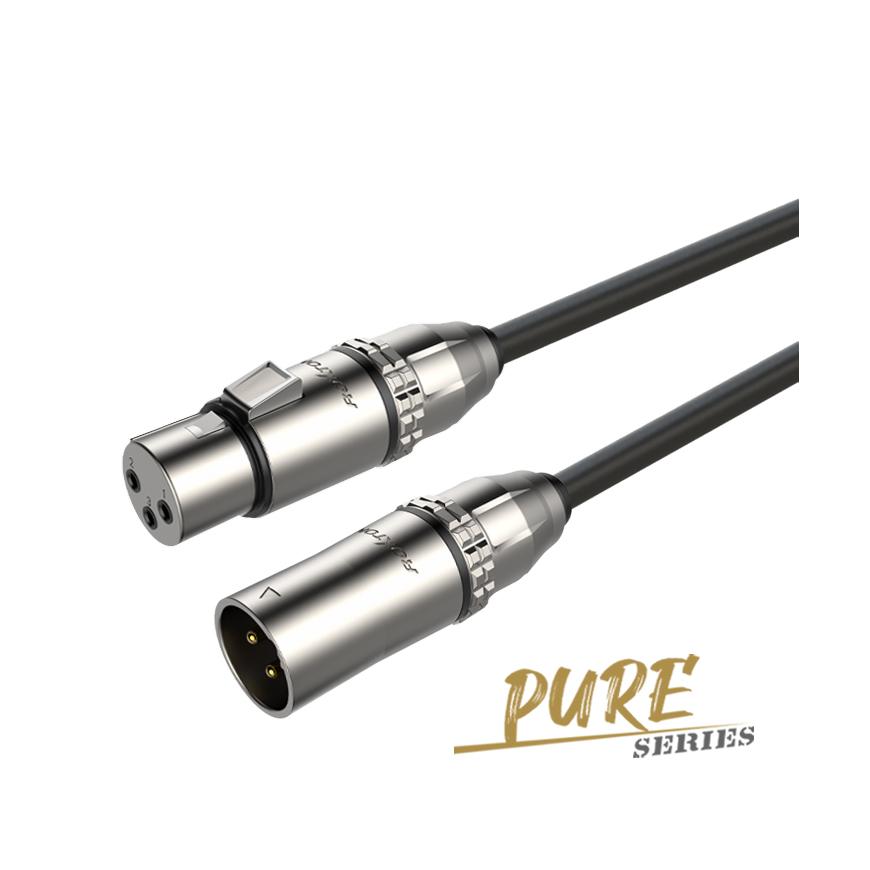
Wireless integration and smart controls drive rapid change in XLR Audio Interfaces. Market projections show wireless audio device sales rising from $56.5 billion in 2024 to $70.9 billion by 2029. Engineers now choose XLR male, adjustable XLR connectors, miniature XLR connectors, and right angle XLR connectors to meet evolving demands.
| Aspect | Evidence |
|---|---|
| Market Size Growth | Wireless audio device market projected to grow from USD 56.5 billion in 2024 to USD 70.9 billion by 2029, CAGR 4.7% |
Key Takeaways
- Wireless integrationin XLR audio interfaces reduces cable clutter, boosts mobility, and improves audio quality, making setups faster and safer for professionals.
- Smart controls and AI-powered features simplify device management, enhance sound precision, and unlock creative possibilities for live and studio audio work.
- The audio interface market is growing rapidly with innovations in wireless and smart tech, so staying updated helps professionals work efficiently and stay competitive.
XLR Audio Interfaces: Overcoming Traditional Limitations
Cable Management and Mobility Constraints
Audio professionals often face challenges with cable management when using XLR Audio Interfaces. Traditional setups require many analog cables, which can create clutter and limit movement. Recent case studies show that switching to networked audio systems, like Dante, helps solve these problems.
- Networked audio systems replace bulky analog snakes with simple network cables or fiber optics.
- The system design changes from complex paths to a clear star or tree layout, making devices easier to reach.
- Routing audio now takes only a mouse click, instead of moving cables or patching devices.
- Labor costs drop because there is no need for crimping or soldering cables.
- Training becomes easier since all devices use the same routing method.
- The system can route hundreds of channels over one network line, reducing cable clutter and increasing mobility.
- Remote access allows monitoring and virtual sound checks from any location.
These improvements make it easier for teams to move equipment and adapt to different spaces.
Maintenance, Safety, and Workflow Challenges
Traditional XLR Audio Interfaces require regular maintenance. Cables can wear out, connectors may loosen, and tangled wires can create safety risks. Teams spend time checking connections and fixing issues, which slows down the workflow.
Networked systems improve safety by reducing the number of physical cables. Fewer cables mean fewer tripping hazards and less chance of equipment damage. The workflow becomes smoother because routing changes happen quickly and devices are easier to manage. Teams can focus more on creative tasks and less on solving technical problems.
Wireless Integration in XLR Audio Interfaces

Breakthroughs in Wireless Audio Technology
Wireless audio technology has advanced rapidly in recent years. Engineers now use noise-cancelling microphones and headsets to improve communication quality and privacy in busy environments. Devices like the Coolpo Ignite headset show how ergonomic design, advanced noise cancellation, and long battery life can work together. These features help professionals communicate clearly, even in open offices or hybrid workspaces.
Wireless headsets now connect easily with smart devices and conferencing software. This supports flexible workspaces and hybrid team collaboration. Companies focus on sustainability by using recycled materials and eco-friendly designs. The demand for adaptable wireless audio solutions grows as more people work remotely or in modular office spaces.
Tip: Adaptive noise cancellation and voice recognition powered by AI make wireless audio devices smarter and easier to use. Companies like Sonos, Bose, Apple, and Sony use AI to adjust sound settings and noise cancellation in real time. These features improve communication and user convenience.
Benefits for Live Sound and Studio Applications
Wireless integration brings many benefits to live sound and studio environments. Audio professionals enjoy greater mobility and flexibility. They can move freely on stage or in the studio without worrying about tangled cables. Wireless systems also reduce setup time and make it easier to change equipment layouts.
A growing body of research highlights the performance enhancements of wireless audio in professional settings. The table below shows how wireless microphones and remote systems improve speech recognition and audio clarity for different users:
| Study (Author, Year) | Focus / Population | Quantitative Outcome / Performance Enhancement |
|---|---|---|
| Thibodeau (2020) | Adults with hearing impairment in group settings | Improved speech recognition in noise using remote wireless microphones |
| Chen et al. (2021) | Hearing aid users in China | Enhanced speech recognition in noise with wireless remote microphones |
| Wesarg et al. (2019) | Single-sided deaf cochlear implant recipients | Improved speech recognition in noise using digital remote wireless microphone technology |
| Jerger et al. (1996) | Elderly persons | Comparison showing assistive listening devices outperform conventional amplification |
| Lewis et al. (2004, 2005) | Hearing impaired individuals | Directional microphones and FM systems improve speech perception in noise compared to hearing aids alone |
| Schafer et al. (2013) | Cochlear implant users | Speech recognition benefits with neck-loop FM receivers |
| Thibodeau & Schaper (2014) | Persons with hearing aids | Benefits of digital wireless technology quantitatively demonstrated |
| Dorman et al. (2021) | Hearing aid users | Persistent benefit of remote and on-ear directional microphone technology even with visual cues |
These findings show that wireless audio systems can deliver clear sound, even in noisy environments. This helps performers, engineers, and audiences experience better audio quality.
ROXTONE, a leader in professional audio solutions, continues to innovate in wireless XLR Audio Interfaces. Their products help users achieve reliable connections and high-quality sound in both live and studio settings.
Real-World Examples of Wireless XLR Audio Interfaces
Many companies now offer wireless XLR Audio Interfaces that meet the needs of modern audio professionals. These devices allow users to connect microphones and instruments wirelessly to mixers, recorders, or speakers. Some popular examples include:
- ROXTONE Wireless XLR System: This system provides stable wireless transmission for microphones and instruments. It features easy pairing, long battery life, and robust signal reliability.
- Sennheiser XSW-D XLR Base Set: This plug-and-play solution offers simple wireless connectivity for microphones. It is popular for live performances and presentations.
- Shure GLX-D Advanced Digital Wireless: This system delivers clear digital audio and automatic frequency management. It is suitable for both stage and studio use.
- Rode Wireless GO II: This compact wireless system supports XLR adapters and offers flexible recording options for content creators and musicians.
These products show how wireless integration transforms audio workflows. Professionals can set up quickly, avoid cable clutter, and focus on creativity. Wireless XLR Audio Interfaces now support a wide range of applications, from concerts to podcasts.
Smart Controls Transforming XLR Audio Interfaces
Digital Management of Gain, Phantom Power, and Settings
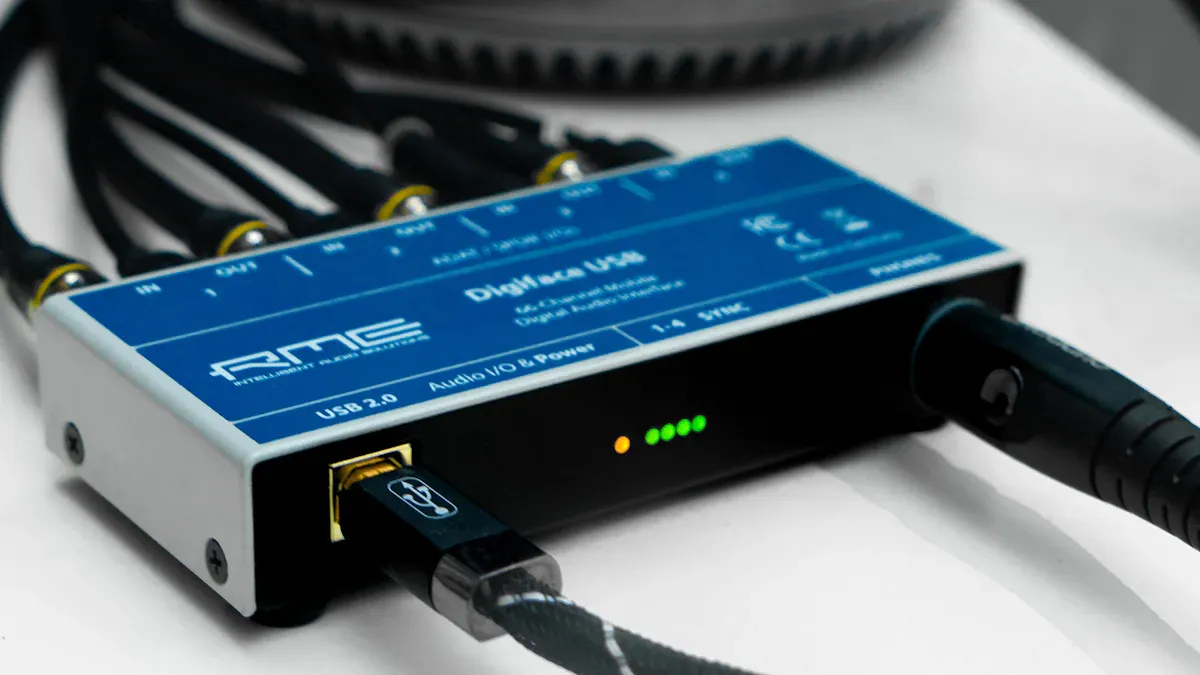
Smart controls have changed how audio professionals interact with their equipment. Digital management now allows users to adjust gain, phantom power, and other settings with precision. Devices like the XTONE Pro smart audio interface show how these features improve both performance and user experience:
- Ultra-low latency and higher dynamic range deliver clearer tone and better sound quality.
- Smart MIDI footswitches and expression pedals offer flexible, multi-effects control.
- Optimized latency and dynamic range outperform traditional audio interfaces.
- Support for professional rehearsal, performance, and recording needs.
- Compatibility with software effects and direct power from iOS devices for added convenience.
- Studio-grade microphone preamps, 48V phantom power, hardware direct monitoring, and MIDI IN/OUT interfaces enhance professional capabilities.
- Smart controls unlock a wide range of effects and creative options not found in older products.
ROXTONE continues to lead in this area by integrating digital control features into their XLR Audio Interfaces. Their products help users streamline setup and access advanced features with ease.
Note: Digital management reduces manual adjustments and speeds up workflow, making it easier for teams to focus on creativity.
AI and DSP Integration for Enhanced Audio Quality
Artificial intelligence and digital signal processing (DSP) now play a key role in modern audio interfaces. NXP Semiconductors' SAF9xxx family demonstrates how AI and DSP integration can improve audio quality in digital interfaces. These audio DSPs combine high-performance cores with neural network engines and hardware accelerators. The result is advanced AI and machine learning audio processing.
This technology supports real-time noise cancellation, voice recognition, and emergency sound detection. It improves both audio quality and safety. The solution works well for low-latency applications and supports many audio and radio use cases. This case shows how AI-enhanced DSP technology can raise the standard for audio experiences in digital interfaces.
ROXTONE also explores AI and DSP integration in their product development. Their focus on innovation ensures that users benefit from the latest advancements in sound processing.
Seamless Integration with Digital Audio Workstations
Seamless integration with digital audio workstations (DAWs) is essential for modern audio production. Performance metrics confirm the importance of this connection:
- Driver stability ensures a consistent link between the audio interface and DAW, reducing crashes and dropouts.
- Low latency monitoring allows real-time input monitoring, improving recording quality and timing.
- High-resolution audio support (such as 44.1 kHz, 48 kHz, 16-bit, 24-bit) guarantees clear, professional sound.
- Compatibility with DAWs and recording equipment ensures smooth operation.
- Built-in DSP enables real-time effects and processing, streamlining workflow and reducing post-production editing.
- Expandable interfaces and connectivity options provide flexibility for different recording setups.
ROXTONE designs their XLR Audio Interfaces to meet these standards. Their products offer reliable driver support, low latency, and high-resolution audio. This approach helps audio professionals achieve seamless integration with their preferred DAWs.
Tip: Choosing an interface with strong DAW compatibility and real-time processing features can save time and improve project outcomes.
Addressing Technical Challenges in XLR Audio Interfaces
Latency, Interference, and Signal Reliability
Audio professionals often encounter latency and interference when using wireless systems. Research in hearing assistive devices highlights how latency can affect speech clarity. For example, delays as short as 1–2 milliseconds may cause comb filtering, while delays above 5–10 milliseconds can create echo effects. In noisy environments, these issues may become less noticeable, but high latency can still disrupt audio-visual alignment if it exceeds 200 milliseconds. To manage these effects, engineers use self-voice detection systems that temporarily disable enhancements during speaking.
Recent advancements in Bluetooth technology have improved performance. Bluetooth 5.0 increased data rates and range, while Bluetooth 5.2 introduced new codecs that reduce latency. Bluetooth 5.3 and 5.4 further enhanced channel selection and connection stability. Bluetooth 6.0 added features like channel sounding and isochronous adaptation, which help maintain reliable, low-latency connections even in crowded environments.
Compatibility with Existing Audio Equipment
Integrating new wireless solutions with legacy audio gear remains a challenge. Many studios and venues rely on analog equipment. Manufacturers address this by designing interfaces that support both digital and analog connections. Adaptors and hybrid systems allow seamless operation between old and new devices. This approach helps professionals upgrade their setups without replacing all existing hardware. Compatibility ensures that teams can adopt new technology at their own pace.
Security Considerations in Wireless Audio Transmission
Wireless audio systems must protect sensitive data from interception and jamming. Modern solutions use strong encryption, such as AES-256, to keep transmissions secure. Public Key Infrastructure (PKI) supports safe key exchanges and digital signatures. Some systems use quantum cryptography for even stronger protection. Anti-jamming techniques like frequency hopping and direct sequence spread spectrum help maintain clear signals. Beamforming and cognitive radio technology further reduce the risk of interference by focusing signals and adapting to changing conditions.
Tip: Always update firmware and use secure passwords to strengthen wireless audio system security.
Practical Impacts for Audio Professionals Using XLR Audio Interfaces
Streamlined Setups and Workflow Efficiency
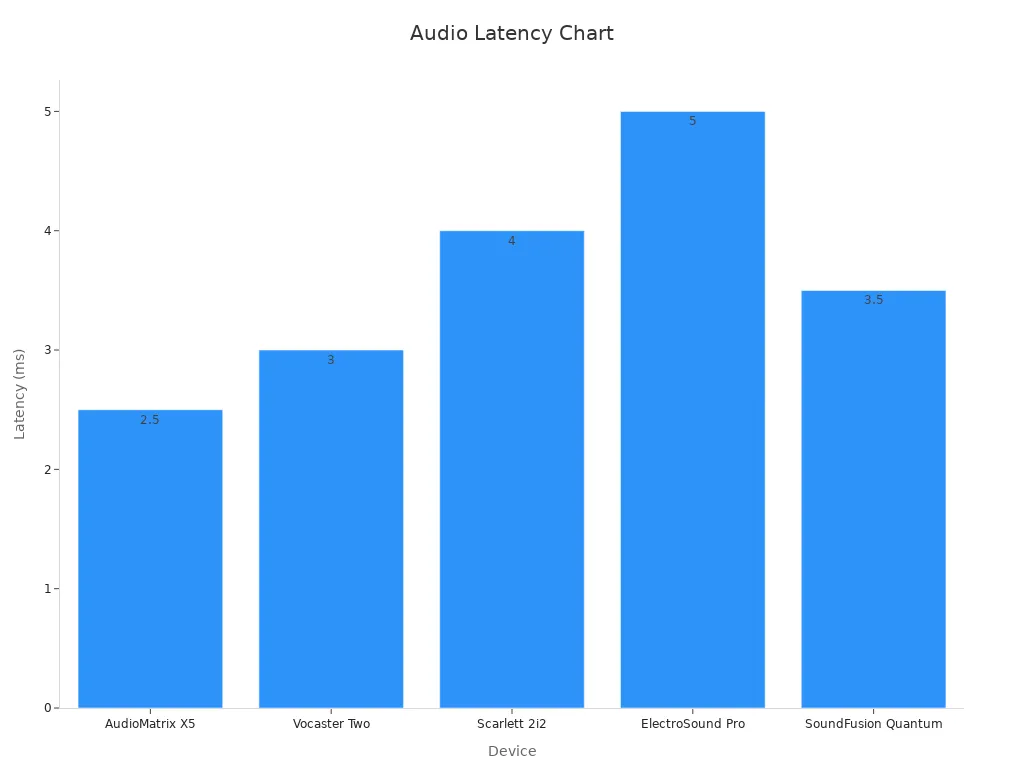
Audio professionals now experience faster and more organized setups. Devices like the DAD AX64 offer modular designs with up to 64 channels and a powerful internal processing engine. This design reduces the need for extra processors and simplifies routing, even in complex environments such as live sound or post-production. Many modern interfaces also feature remote control, cloud sync, and AI-driven noise cancellation. These features help teams work more efficiently and reduce setup time.
| Device | Latency (ms) | Unique Features |
|---|---|---|
| AudioMatrix X5 | 2.5 | Remote control integration, cloud sync |
| Vocaster Two | 3 | AI noise cancellation, ultra-low latency |
| Scarlett 2i2 | 4 | Plug-and-play, robust driver updates |
| ElectroSound Pro | 5 | Multiple I/O, modular firmware upgrades |
| SoundFusion Quantum | 3.5 | Hyper-synced clocks, dynamic firmware |
Expanded Creative Possibilities and Portability
The audio production equipment market reached about $1.2 billion in 2023. This growth shows how important modern interfaces have become for both home and professional studios. New technology, such as digital signal processing and wireless solutions, gives users more creative options and greater mobility. Many professionals now use compact, portable devices that support high-quality audio from almost any location. The shift to digital workflows and cloud-based editing also allows teams to collaborate from different places, making creative projects more flexible and dynamic.
Cost, Training, and Adoption Considerations
Adopting advanced audio interfaces often leads to cost savings, but training remains important. Studies show that 82% of digital health interventions are cost-effective or save money compared to traditional methods. However, the cost of training and supervision can affect overall savings. Teams must consider these factors when planning upgrades. Economic reviews highlight that including training costs in budgets helps avoid wasted resources. Scalability and the size of the upgrade also play a role in determining cost benefits.
Future Trends and Predictions for XLR Audio Interfaces
Industry Adoption and Market Shifts
Industry experts expect the audio interface market to grow rapidly over the next decade. The market valuation reached about USD 7.5 billion in 2022. By 2030, projections show the market could reach USD 13.5 billion, with a compound annual growth rate near 7.5%. This growth comes from rising demand for high-quality sound in live events, studios, and content creation. North America and Europe lead in adoption, but Asia-Pacific shows the highest growth potential. The table below highlights key market trends and drivers:
| Aspect | Details |
|---|---|
| Market Valuation (2022) | Approximately USD 7.5 billion |
| Projected Market Size (2030) | Estimated USD 13.5 billion |
| CAGR (2023-2030) | Around 7.3% to 7.5% |
| Key Market Drivers | Demand for high-quality sound, live events, studios, content creation |
| Technological Advancements | Wireless tech, Bluetooth, AI-driven enhancements |
| Regional Growth | Strongest in North America/Europe; fastest in Asia-Pacific |
| Product Trends | Portable, multifunctional, smart devices |
Innovations in Wireless and Smart Control Technologies
Manufacturers continue to push boundaries with wireless and smart control features. Bluetooth connectivity and AI-driven audio enhancements now appear in many new products. Portable and multifunctional devices attract both professionals and amateurs. Immersive audio and spatial sound processing gain popularity, especially among content creators and broadcasters. Major brands focus on innovation and global partnerships to stay ahead. The following table shows how the market segments and adoption rates shift:
| Category | Details |
|---|---|
| Market Segmentation | By Component: Hardware, Software, Solution |
| By Type: USB, Firewire, MIDI, Thunderbolt | |
| By Application: Professional, Amateurs | |
| Market Size & Growth | Expected to reach USD 266.87 million by 2028, CAGR of 6.0% |
| Regional Adoption | North America leads; Asia-Pacific rising |
| Competitive Landscape | Focusrite, Universal Audio, Steinberg, Zoom, Roland, and others |
| Market Drivers | Demand for high-quality recording, new interface types |
📈 Note: The shift toward smart, wireless, and portable solutions will likely shape the next wave of audio technology.
Preparing for the Next Generation of Audio Production
Audio professionals prepare for a future where technology changes quickly. They invest in training and flexible equipment. Teams look for devices that support both legacy and new workflows. Manufacturers respond by offering products with modular designs and software updates. As immersive and AI-based audio tools become standard, users adapt their skills to stay competitive. The next generation of audio production will rely on smart controls, wireless integration, and global collaboration.
Wireless integration and smart controls push XLR Audio Interfaces into a new era. They give audio professionals more flexibility and efficiency. Early adopters gain a clear advantage.
Staying updated helps teams deliver better sound and prepare for future workflows.
By: Roxtone
Tel: +86 574 87154705
Fax:+86 574 56138190
E-mail: [email protected]
Facebook: Roxtone
Youtube: Roxtone
X: Roxtone